
Investigative study on Reza Pahlavi's gross exaggeration regarding the number of participants in the Munich rally on February 14, 2026
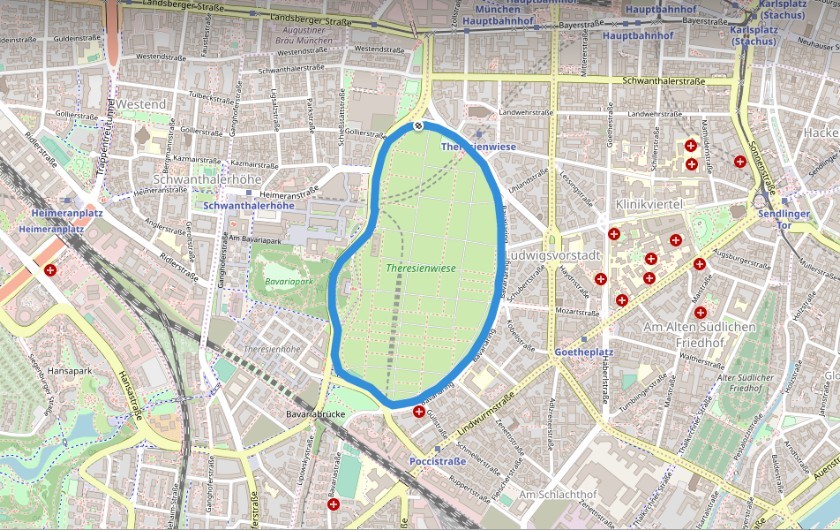
The following investigative analysis was prepared by the "Iranian Society in Munich" based on the observations of 10 eyewitnesses and the recording and analysis of dozens of video recordings between 11:00 and 18:00 at the event location, in the surrounding streets around the Theresienwiese and the nearby subway station, on public transport in Munich, at the airport and at the central train station, as well as in comparison with previous demonstrations at the same event location.
The aim of this report is to objectively examine the veracity of the claim regarding the participation of 250,000 people in the monarchist rally on February 14, 2026 in Munich, in order to gain a realistic view.

The event venue “Münchner Theresienwiese” covers a total area of approximately 42 hectares (420,000 square meters).
First Statistical Assessment
According to press reports from the organizers, participants in the rally arrived in 800 buses. Based on this number and assuming an average of 40 passengers per bus, the estimated number of participants who may have arrived by bus would be 32,000.
Based on a random count of public transport passengers and private cars near the venue, an additional 8,000 people could have arrived by private and public transport (train, plane, car), assuming an optimistic estimate. This would bring the total estimated attendance to approximately 40,000. Therefore, the alleged attendance of 250,000 would be 5.25 times higher than this estimated figure.
While on-site observations and the traffic reports on trains, S-Bahn and U-Bahn lines to the venue, the central train station and Munich Airport showed normal operations, the streets around the venue were busy, but not excessively crowded.
Second Statistical Assessment
Even assuming optimistically that 20,000 people (2.5 times the estimated number of participants by on-site observers) arrived by private car and public transport by air and land – although the passenger traffic at the airport, the central train station, and city traffic proves otherwise – the following question arises, to be asked of the event organizers: Where were the buses carrying the remaining 230,000 people (250,000 – 20,000 = 230,000), namely approximately 5,750 buses with 40 passengers each (although the average number of passengers in the spot checks was significantly lower), parked in Munich? This large number of buses would have led to massive traffic congestion in the city. Yet, heavy traffic was only observed around the Theresienwiese!
Third Statistical Assessment
The Oktoberfest takes place every year on Munich's Theresienwiese. Huge beer tents are erected there, each offering space for 7,000 to 10,000 people. At 4:00 p.m., during Reza Pahlavi's presence, the crowd on the grounds filled an area smaller than three of these beer tents (Hofbräu/Löwenbräu). Taking the crowd density into account and using an optimistic estimate, the number of visitors would be limited to around 30,000.
The number of people scattered across the grounds or frequenting the surrounding area was determined in blocks and estimated at approximately 3,000. In addition, those participants who would have left the grounds before 4:00 p.m., as well as all those who would have arrived after 4:00 p.m., were generously estimated at a total of 5,000 (journalists and police calculations typically include a 15 to 20-percent surcharge). Taking all these optimistic assumptions into account, the estimated number of participants would be around 40,000. The organizers' claimed number of 250,000 participants is 6.25 times this figure!
Note: Eyewitnesses and reporters on site have reported a large number of people moving around the grounds between 12:30 and 16:00 hrs. This could have been very misleading for electronic surveillance systems monitoring the venue.
Fourth Statistical Assessment
ChatGPT's analysis of the complete video footage recorded during Reza Pahlavi's presence and speech:
Content:
· This analysis was conducted technically, impartially, and transparently.
· Crowd assessment analysis
· Spatial coverage analysis and crowd density analysis
Executive Summary
This analysis provides an independent calculation of the number of participants in the rally on the Theresienwiese in Munich. This calculation is based on a visual analysis of video recordings.
The methodology is based exclusively on recognized principles of crowd science and takes the following into account:
· The area covered by the crowd (spatial coverage)
· The pattern of crowd density (density analysis)
· The known dimensions of the area covered by the crowd
This analysis/report does not base its calculations on political, partisan, or media claims/statements.
Methodology
The estimate of the number of participants was carried out according to recognized standards of agglomeration analysis:
1. Determination of the actual area covered by the participants
2. Estimation of the spatial extent of the crowd
3. Classification of participant density based on the distance between individuals
4. Calculation of the number of participants = Area × Density
Spatial Coverage Analysis
Based on frame-by-frame analyses of video footage at the peak of the event – approximate dimensions of the main crowd area:
· Width: approx. 200 meters
· Depth: approx. 150 meters
Estimated area covered by the crowd = Approx. 30,000 square meters
Analysis of Crowd Density
The analyzed pattern indicates the following:
· High human density
· No critical human density
· Limited but existing distance between individuals
Corresponding Crowd Density in Scientific Studies
· 1.2 to 1.6 people per square meter in the front rows, where the crowd is denser (front third of the crowd)
· 0.6 to 1 person per square meter in the back rows, where the crowd is less dense (last two thirds of the crowd)
More realistic crowd density = an average of 1 person per square meter, averaged over the entire area
Estimated Number of Participants
Based on standard scenarios:
· Conservative scenario ≈ 24,000 participants
· Realistic and reasonable scenario ≈ 31,000 participants
· Optimistic scenario (upper limit) ≈ 40,000 participants
ChatGPT's Conclusion
Based on the technical analysis:
1. Realistic and reasonable number of participants = 31,000 people at the time the video was recorded
2. The observed crowd does not correspond to gatherings of several hundred thousand people.
End of ChatGPT's analysis
Including an estimated 8,000 people scattered across the site, as well as those who probably left the site before the start of video recording or who might have not yet arrived, the final estimated number of participants, 39,000, seems plausible according to ChatGPT's analysis. A propagandistic, but still justifiable, estimate puts the maximum number of participants at 48,000. This would still represent a five- to six-fold increase over the actual number of participants.

Fifth Statistical Analysis – a Review
On February 15, 2025, coinciding with the Munich Security Conference, supporters of Reza Pahlavi gathered at their maximum in anticipation of his participation. According to on-site monitoring by several observers and a precise count of the participants coming from Europe, US, and Scandinavia the total number of attendees ranged between 350 and 400. The march of demonstrators, which stretched along the city's main street, was approximately 253 meters long, including a 30-meter-long flag. The organizers of the event claimed 21,000 participants, roughly 52 times the actual number (350 to 400).
The final conclusion regarding the actual number of participants at the venue on February 14, 2026 is left to the readers themselves.